What is a “modular home”?
A modular home is a house built in sections at a factory, then transported to its final site and assembled on a foundation. It’s not one single type of construction, though. There are two very different categories, on-frame and off-frame, and the difference between them matters a lot more than most buyers realize.
What is an “on-frame” modular home vs “off-frame”?
On-frame modular homes are essentially mobile homes. They’re built to HUD code (the U.S. Department of Housing and Urban Development standard) and delivered to the site on a permanent metal chassis, or “frame,” that allows the home to be transported. In most cases, these homes are placed on a permanent foundation with no intent to move them again. That permanent foundation is required if the buyer wants to obtain a mortgage on the home. These homes also have a certificate of title, just like a vehicle would have. To convert the mobile home to real property, the title must be cancelled with the DMV.

Staged Living Room in an Off-Frame Modular Home
Off-frame modular homes are a different animal entirely. They’re built to North Carolina Building Code, the same code used for stick-built homes, and once they’re set on a foundation, there’s no chassis left underneath them at all. This is actually one of the most common questions we get in the Asheville market: what’s the real difference between modular and “stick-built” construction? Honestly, off-frame modular and site-built homes are built to the same code, and most people can’t tell them apart just by looking.
The real distinction comes down to where the work happens. Off-frame homes are built in a factory rather than outdoors on-site, so the materials never sit exposed to Asheville’s weather during construction. Because weather isn’t a factor, most off-frame modular homes are built in six months or less. Most are also built with 2×6 walls rather than the more common 2×4, which means better insulation than a lot of comparable stick-built homes.
The home’s foundation is still built on-site while the modular sections are under construction at the factory. Basements are common in this area, and poured concrete walls tend to be the popular choice for them. Concrete block crawl spaces are also typical in the Asheville area.
Pros and Cons of Modular Homes
Benefits of Modular Homes
- Modular homes can be fully customized. Most manufacturers offer dozens of floor plans, and once you’ve picked one, you work directly with them on finishes and details, flooring, cabinets, trim style, window sashes, siding, colors, etc. A common request we see in the Asheville area is adding cedar shakes within the gables for a craftsman look. You can also add site-built features afterward, like a garage built on-site after the home is placed, or a deck added or expanded beyond the original plans.
- Off-frame modular homes are typically faster to build and better insulated. Off-frame homes go up in a factory rather than outdoors, so weather doesn’t slow things down, and most are built with 2×6 walls rather than 2×4, which means better insulation than a lot of comparable stick-built homes.
- Traditional homes and off-frame modular homes appreciate similarly. In our experience, a well-designed off-frame modular home can be just as visually appealing as a custom site-built home. From an appraisal standpoint, they are constructed similarly and should appreciate in value similarly. Importantly, we’ve never seen a difference in the lending or insurance processes between the two.
Common Issues with Modular Homes
- Modular homes may not be allowed in some neighborhoods. Deed-restricted neighborhoods with Architectural Review Committees (ARC’s) or Design Review Boards (DRB’s) may not allow modular construction. When reviewing the neighborhood construction guidelines, look for terms like “pre-fabricated” or “delivered to the site in sections.”
- Timing depends on more than just the factory build. The home itself might only take a few months to build, but site work, permits, and the foundation still have to follow a normal construction timeline, and a delay on either side holds up the whole project.
- Some buyers and lenders still carry outdated perceptions. Even though off-frame homes are built to the same code as stick-built houses, the word “modular” still gets unfairly associated with lower quality by some buyers, appraisers, and lenders, though that gap keeps closing.
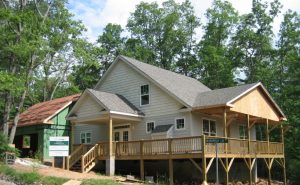
A modular home under construction in Black Mountain, NC. The deck and the garage were built on site after the main home was set in place.
Our Favorite Off-Frame Modular Home Neighborhoods in Western North Carolina
Padgett Place | Black Mountain, NC | Low-Maintenance Properties Close to Downtown
Black Mountain’s Padgett Place neighborhood offers newer off-frame modular homes with easy-to-maintain yards. These homes are nicely upgraded, and there is a mix of single-story homes and homes with a basement.
See homes for sale in Padgett Place.
Mountain Vista at Luther Cove | Candler, NC | Community Convenient to I-40
Mountain Vista dates back to 2012 and sits just minutes from I-40, with homes typically priced affordably.. It’s a low-maintenance, HOA-supported neighborhood close enough to Candler and West Asheville to make commuting easy without giving up a quieter setting. The neighborhood playground is a fantastic amenity!
See homes for sale in Mountain Vista at Luther Cove.
Willow Creek Village Townhomes | West Asheville, NC | Low Maintenance Living in a Convenient Location
You’ll find Willow Creek Village between Candler and West Asheville, with low-maintenance off-frame modular townhomes and an HOA that handles exterior upkeep and landscaping. It’s a lock-and-leave kind of setup, great for anyone who’d rather spend weekends exploring in the Blue Ridge Mountains than doing yard work.
See homes for sale in Willow Creek Village.
Connect with one of our experienced Realtors to discuss modular construction
Click above to email us, call us at 828-419-0444, or fill out the form below to talk with one of our agents.
Related Posts:

How a Real Estate Agency Works in North Carolina

How to Choose a Realtor in Asheville, NC: The Right Questions to Ask to Find Your Best-fit Agent

Moving to Asheville, NC

What Is a Survey in Real Estate? Understanding the Scope and Value of a Property Survey